





In the farmer's calendar, August is synonymous with the Santa Marija Agrarian Fair, known locally as Il-Premju (The Prize)—a long-standing celebration of craftsmanship, agricultural produce, livestock, and the island's rural heritage. Against this backdrop, VisitGozo met with Max Scerri of Nelli’s Ċarkuterija, a young chef and artisan whose work is shaping a new chapter in Gozo's culinary story.
In the farmer’s calendar, August is synonymous with the Santa Marija Agrarian Fair, known locally as Il-Premju (The Prize)—a long-standing celebration of craftsmanship, agricultural produce, livestock, and the island’s rural heritage. Against this backdrop, VisitGozo met with Max Scerri of Nelli’s Ċarkuterija, a young chef and artisan whose work is shaping a new chapter in Gozo’s culinary story.
Sitting down on one of the benches at his outlet in Palm Street, Max comes across as a young entrepreneur with a clear vision. “We are trying to create something that is very much local, instil a sense of pride in our use of food”, he says, explaining that currently most of his operations are focused on the curing of meat. This base serves both as the place where all products are prepared and stored, and as the outlet where Max hosts tasting events.
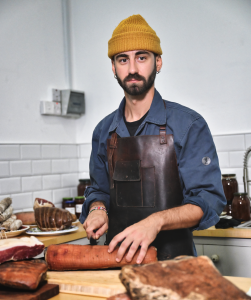
Having barely touched his mid-twenties, Max has embarked on a journey that has taken him to one of the oldest food crafts. When asked how he ended up in his own store curing meats, Max recounts his passion for cooking. Even while he was in post-secondary school, his heart was already in cooking. His dream was to become a chef, and by the time he sat for his A-level exams, he had already found a full-time job in a restaurant kitchen. He fell totally in love with this profession, and his culinary journey has taken him to renowned kitchens across Europe. He returned home to Gozo from London, where he had been working during the pandemic. He planned to be home for a short period of time, but when he started working in a local kitchen, he got involved in new and interesting projects. Soon, he realised there was potential to do more and wound his way down the path of producing cured meats and even growing his own produce.
Max’s dream is not a run-of-the-mill one, nor one he really set out to do and, as he says, “it’s all novel”. In fact, he simply had the chance to experiment in restaurant kitchens, creating cured meats and introducing them to the menu. When the idea caught on, several restaurants asked him to prepare charcuterie for their menus. He looks back at the time when he was working full-time in a restaurant while producing cured meats on the side for the same establishment. Although it started as a hobby, he found himself working 80–90 hours a week. Eventually, he realised there was a gap in the market for genuinely appreciated products and decided to take the plunge by opening his own charcuterie. Historically, the islands have not had a strong tradition of curing houses, and Max quips that even the name he picked for his enterprise had to be invented. Naturally, as a chef, it was only a matter of time before his curiosity extended beyond charcuterie to other preserved foods, including cheeses, kombucha, jams and preserves.
With a wistful look, he explains that when he was working in London, he felt very disconnected from the actual produce. As a chef, he would send out orders first thing in the morning, and by three hours later, he would receive premium produce, which he would then trim, portion and serve to customers. Despite thriving in the typical high-stress Michelin-star level, he craved getting closer to the real produce. In a particular way, the Michelin-star experience brought him back to the roots, helping him discover the authentic and try to do things differently.
Today, Max is set on reviving time-honoured practices while giving them a contemporary expression, showcasing the authentic flavours of Gozo. He insists that this has nothing to do with being romantic but is a heartfelt mission to build, sustain and take pride in our food culture. He deftly explains that in our age, we do not really need to produce cured meat, and the operations he and his team are engaged in are purely for the sake of luxury and authentic taste. Refrigeration has eliminated the need to preserve meat with salt. It is precisely here that craftsmanship comes into play. Opting to forgo the simple, easy option of refrigeration, Max is focused on the craft of experimenting, creating what he describes as “a dialogue with the food itself, where each mouthful has a story to say”.
The process of curing meat requires patience. Max works mostly with local pig farmers, acquiring the animals, carefully butchering them, and preparing each cut individually by hand. The cut is then left to cure in salt for about two to five weeks, depending on its size. Everything is done by hand, following traditional methods used a century ago. Salamis follow a different route. The product is first made into a sausage, then fermented, air-dried or smoked, depending on the variety, before it is cured, a process that typically takes between one and two months.
For Max, craftsmanship extends far beyond the curing process, but it is equally about ensuring that nothing goes to waste. The bones are turned into stock, and what remains is eventually ground and spread in the fields to become compost. Sustainability is not a loose term he picked up along the way, but one he practises every day, and he says there’s a lot of beauty to be found in things that could have been discarded.
Above all, the process demands patience. It is a quality that Max says he discovered while producing charcuterie, bread, cheese and preserves. Good food needs time, and waiting is part of the game in food production. The farmer waits for the produce to grow; bread needs time to rise; and cheese, cured meats and preserves all need time to mature. For someone still at the beginning of his journey, each stage has become a voyage of discovery. Smiling, Max admits, “I never thought I was a patient person, but it seems like I’ve discovered a new side of me.”
For Max, the core of artisanal products is local ingredients and a strong sense of terroir—the belief that the landscape itself shapes flavour. His products have a remarkably short ingredient list. “We have great quality pork, and we have the sea salt, which is the most important thing,” he says passionately, explaining how he grows his own herbs or forages for them to create flavours that are unmistakably Gozitan.
Today, Nelli’s Ċarkuterija offers a growing range of handcrafted products inspired by Gozo’s landscape and culinary traditions. Alongside its signature cured meats, which now include lamb and beef alongside the traditional pork, are salamis flavoured with local ingredients such as wild fennel, chilli and oregano, each reflecting Max’s philosophy of working with what the island has to offer.
His dreams, however, extend beyond his charcuterie, tucked away in one of Victoria’s narrow cobbled streets. The shelves at Nelli’s Ċarkuterija, lined with homemade preserves, pickles and seasonal creations, already hint at a farming estate where ingredients are grown, reared, produced and preserved within a single closed-loop system.
As Max quietly evolves his vision, he seems to resonate more and more with Gozo’s farming heritage, preserving something much greater than cured meats and salamis — the knowledge, traditions and rural identity that have shaped Gozo for generations.
Note: Max Scerri is one of four young Gozitan food producers featured in Of Soil and Sea, a short film commissioned by the Ministry for Gozo, written by Clare Agius and directed by George Scicluna. The film has been named winner of the Young Food Producers category in IGCAT’s Food Film Menu 2026, an international competition that celebrates short films on food heritage, sustainability and local identity.
The film is now in the running for the Public’s Favourite award, which is decided by an open public vote. Voting closes on 30 August 2026, with the result announced at the World Gastronomy Summit Gala on 17 October 2026. If film’s story resonated with you, please watch the film and cast your vote here.
VisitGozo would like to thank Max Scerri of Nelli’s Ċarkuterija for this interview and for kindly sharing the photographs.
BACK TO BLOG POSTS