






As the island embraces an early Lent, preceded by the whirlwind of colourful and energetic days of Carnival, VisitGozo anticipated the season by catching up with Jamie Camilleri to reflect on a season that blends faith, theatre and tradition.
A family man and seasoned educator, Jamie is heavily involved in drama in Gozo. He teaches at the Gozo Visual and Performing Arts School and serves as a drama teacher at the Gozo College. He quickly summarises his life as one spent on stage, rooted in performance since the age of sixteen, with an enduring involvement in Good Friday drama and pageantry that dates back to 1998.
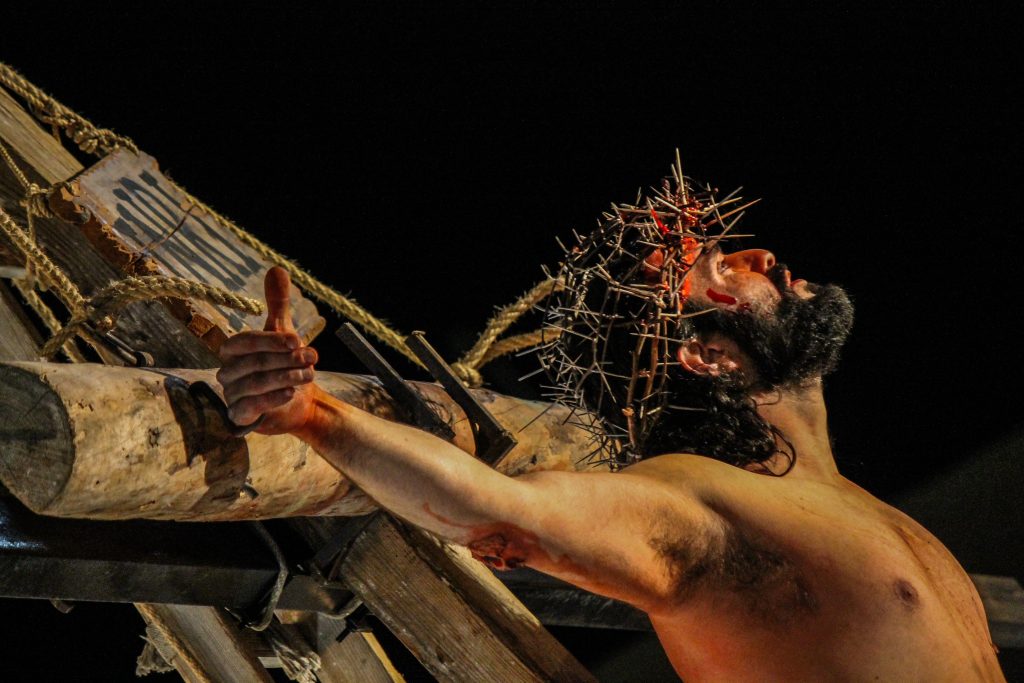
His first foray with the Għaqda Dilettanti tal-Ġimgħa l-Kbira (The Good Friday Enthusiasts Association) was simply as an extra in the cast of the drama L-Imsallab (The Crucified), which, in those years, was a passion drama staged indoors at the Oratory Theatre in Gozo. In the year 2000, he vividly recalls the organisers transforming the production into something entirely different by staging it as an outdoor pageant in the streets of Victoria. It was envisioned as the organisation’s millennium project, bold, innovative and ambitious. Excitement ran high, as did the uncertainty and the doubts about the attendance of the people till the very last hour. Yet, true to the words of the late Fr Louis Bezzina, the people filled up the streets as soon as the play began, turning the performance into a success! This was a major turning point, with the play being renamed L-Imsallab fi Triqatna (The Crucified in our Streets) and since then, the organising team has never looked back.
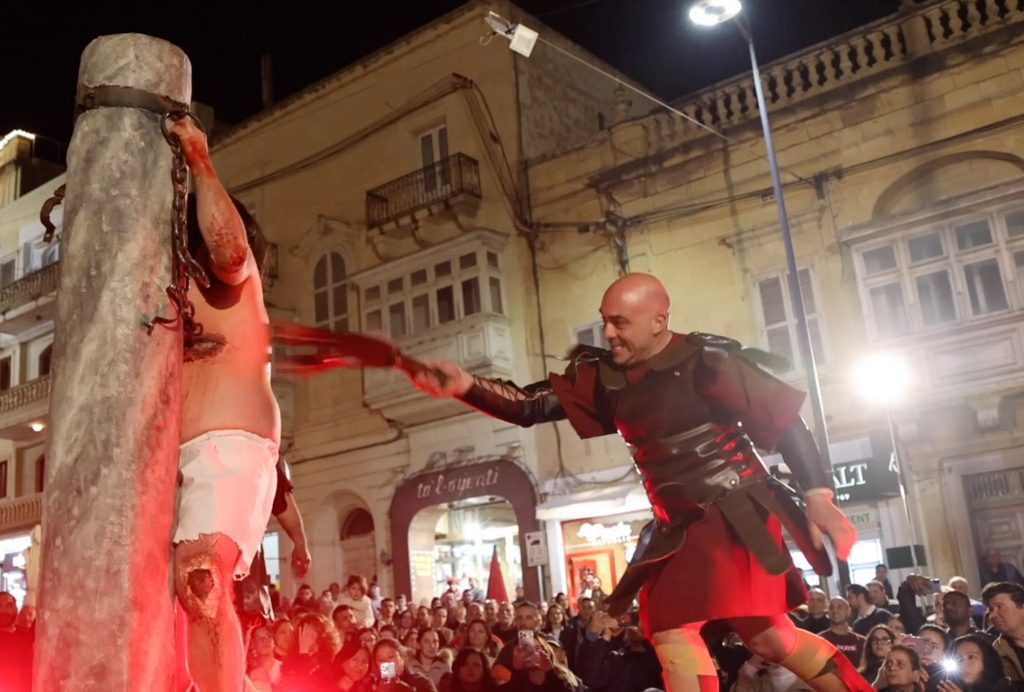
As for Jamie himself, his journey within the Għaqda Dilettanti tal-Ġimgħa l-Kbira mirrors the wholesome spirit of growth that the organisation fosters. He went from an extra to a ‘seller at the temple’ and later to a ‘Roman guard’, and with time, he undertook greater responsibility. He was entrusted with staging the Flagellation at the Pillar and the Crucifixion scene, two of the most critical and gruelling scenes that demand logistical precision and deep reverence. Later, he would be asked by the organisation’s President at the time, Mr George Cassar, to play the role of Christ. Jamie was then 33 years old, and he portrayed Christ for 13 years. Today, Jamie serves as the president of the organisation.
When asked about his passion for Good Friday, Jamie confesses it was the theatre that sparked his faith. In his younger years, Good Friday was ‘just another feast’ for him. The theatre involvement piqued his interest and deepened his understanding. Today, as president of the organisation, he observes a similar transformative pattern among many of the youths who participate, where involvement leads to reflection and reflection ushers in conviction. His journey through the years has meant continuous research into the historical and biblical figure of Christ, the man he considers the most widely known person ever to walk the earth. Regardless of religious belief, Christ is a universal reference point in human history.
As a seasoned theatre man, Jamie, now 48, pauses to reflect on his portrayal of Christ, a demanding role he has now entrusted to a younger actor. Being a live pageant, there is no room for hesitation, and within 90 minutes, the actor is called to embody an entire spectrum of intense emotions. He speaks candidly about techniques for summoning emotions, such as fear on cue, and the balance and discipline needed to avoid going overboard with emotions. There is a real risk of lapsing into exaggeration and all can be lost in a moment if the profound suffering is turned into unintended parody. Performing in the streets adds another layer of complexity. As the audience stands only a couple of feet away, comments can be overheard, and reactions can be instinctive. The actor has to remain focused within an ‘inner’ bubble, present yet undistracted. There is no doubt that it was a challenging role, but one which Jamie is still very passionate about. Undoubtedly, his portrayal of Christ has rubbed off on him, leading him to pursue every detail that would make the performance more authentic.
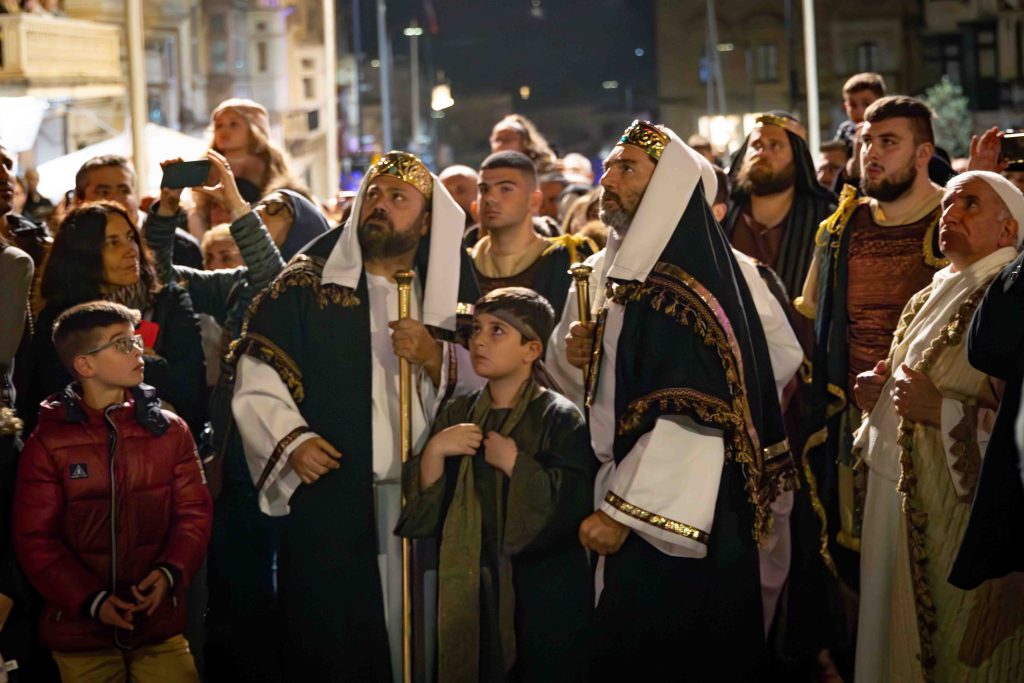
The commitment to historical accuracy is far from casual. From correct biblical sequencing to minute details, the organisation is keen to present a production rooted in research. He explains that over the years, they adjusted several aspects, such as ensuring that Judas leaves the Last Supper before the Washing of the Feet. Such changes are not haphazard but occur after research and consultation with biblical experts, such as Mons Lawrence Sciberras. Even small details matter. One such case is the number of lashes Jesus received during the scourging at the pillar. Jamie explains that traditionally, the number was cited to be 39 lashings, but this is the number tied to Jewish punishment. The Roman beating was not tied to a fixed number, and the prisoner’s ordeal only ended when he could no longer endure it and fell to the floor. In this respect, Jamie notes the accuracy of Mel Gibson’s The Passion of the Christ and comments on how Gibson captures the Roman brutality as it truly happened. For the Għaqda Dilettanti tal-Ġimgħa l-Kbira, the emphasis is on faithful storytelling that depicts the last hours of Jesus before his agony on the cross.
Today, the L-Imsallab fi Triqatna ropes in a cast and production team of over 75 individuals of all ages. Every year, the team works hard to deliver a realistic production, striving for occasional variation and interjecting beloved stories from the Gospel, such as the Samaritan Woman at the Well, the Raising of Lazarus, and the Penitent Woman. Naturally, all this takes place along streets, and thus organising logistics and adapting the staging to suit the street backdrops are part of it. The organisation depends entirely on volunteers to stage one of the most anticipated pageants on the island, one that has become a living tradition.
The L-Imsallab fi Triqatna is not the only initiative organised by the Għaqda Dilettanti tal-Ġimgħa l-Kbira. Another significant event is the Good Friday exhibition. Held at the Augustinian Convent in Victoria, the exhibition is a curated collection of art and artefacts of different artistic backgrounds and traditions. Preparations start in December, when the organisation invites artists to present their own creations, such as statues and dioramas, paintings, metalwork and metal statues, items made from recycled materials, and papier-mâché, all in the theme of Good Friday. Even antique shops contribute by sharing unique artefacts, and sometimes the exhibition includes particular statues from churches.
Four years ago, the group decided to introduce the contemporary concept of installation art. Last year’s striking installation involved two empty chairs in a bare room that represented Christ’s interrogation by the High Priests Caiaphas and Annas at the Sanhedrin. Designed to foster an intimate spiritual engagement, visitors could hear the interrogation as if they were in Christ’s place.
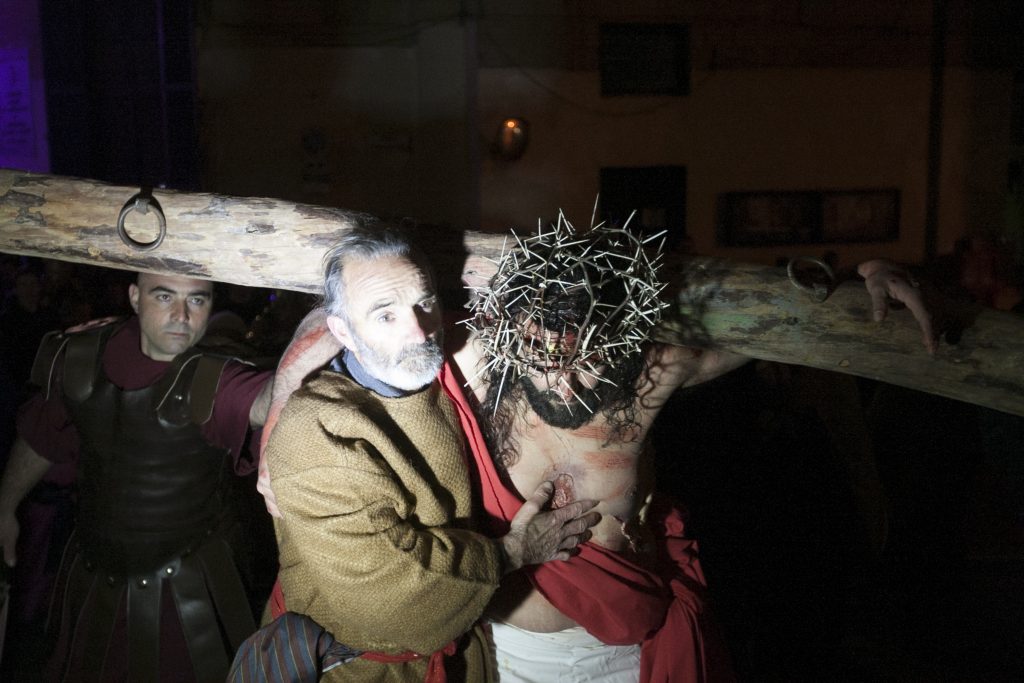
The commitment to realism is evident not only in the pageant but also within this exhibition. Jamie explains that he has commissioned a series of dioramas that are based on the actual street pageant, with the figures being modelled on the real participants. These multi-angled compositions capture natural movement and are meant to be appreciated from different perspectives. The most treasured diorama is the one depicting Simon of Cyrene and Christ sharing the cross on the road to Golgotha. Jamie explains this is a personal tribute to his late father, who, for four years, played Simon of Cyrene alongside Jamie, who played Christ. Without doubt, this carries deep personal significance and, even today, remains a profoundly moving moment in father-son memory, now preserved in art.
Commenting on what keeps Good Friday alive in Gozo, Jamie does not hesitate. The sombre church functions are central to the feast. Unlike the more commercial Christmas season, Good Friday retains a raw depth that has a greater impact on the human spirit. He also points to the dedicated artists who pour their passion into creations tied to the season. Adding to all this is the voluntary spirit of organisers and their teams, which lies at the core of everything and often generates infectious interest among younger participants.
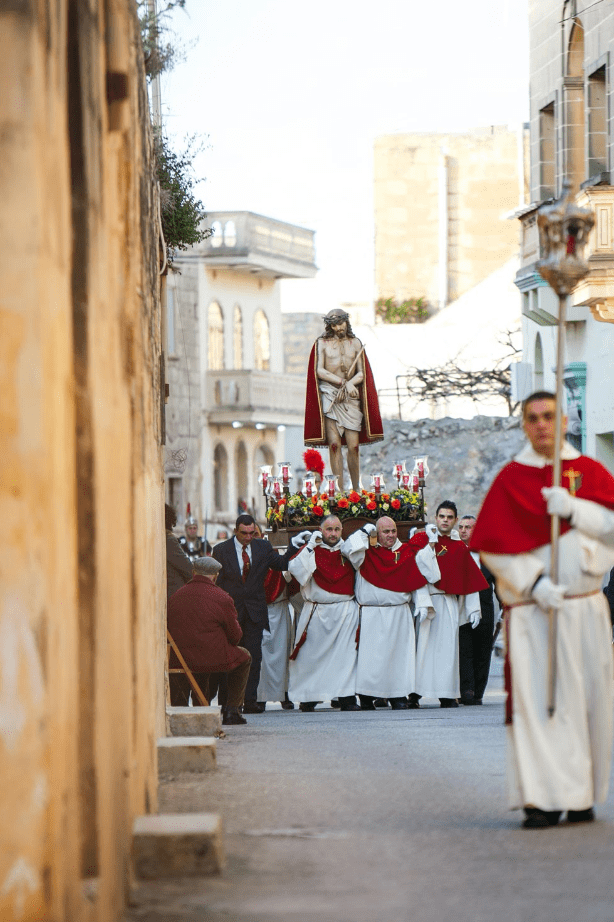
For those visiting Gozo during the season, Jamie’s advice is simple – attend at least one devoted religious procession. Naturally, he invites everyone to attend this year’s edition of L-Imsallab fi Triqatna (happening on Saturday 28th March) and reminds that the Exhibition at St Augustine Convent (open 22nd March to 5th April, at different times) is conveniently open on Maudy Thursday, when many follow the Seven Visits devotion. Gozo also offers other activities during Holy Week, and it’s always worth checking them out. After all, he says, some might not be interested in attending church functions but can still experience the introspective vibe of the season.
His final message is rooted in the belief that keeping Holy Week traditions alive is essential to Gozos’ religious identity. Carrying this legacy into the future is about appreciating the commitment of the voluntary community revolving around faith, theatre and art, all of which culminate into one powerful experience.
BACK TO BLOG POSTS